Schola Graeca
A Classical Greek course
ΤΟ ΔΙΔΑΣΚΑΛΕΙΟΝ
github.com/correll/greek-classroom-rome — the course and its sources, free to read, copy and adapt.
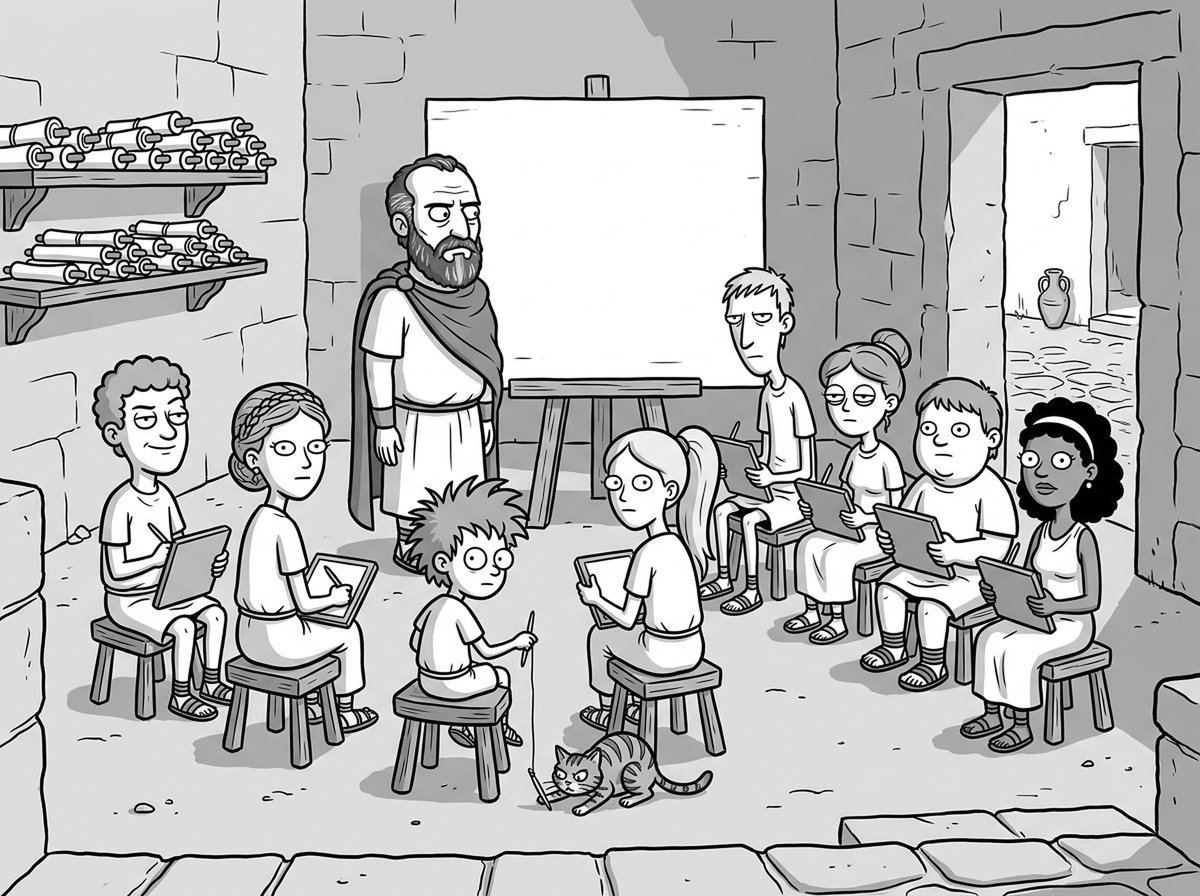
Rome, autumn of AD 400. Eight Latin-speaking children in a household school on the Caelian Hill are made to study Greek by a grammarian from Antioch. They find the language old-fashioned, the declensions infuriating, and their teacher's expectations unreasonable. Over thirty-six lessons they discover that the ancient authors are not dusty authorities but people who asked questions that still matter.
This is a complete Classical Greek course, built as a continuing story. Each lesson advances the pupils' Greek and their relationships with one another. Their classroom mischief provides the comedy; the texts themselves provide the substance.
Start here
The course in six movements a lesson, and what it assumes you know.
Lesson 1
Marcus objects that they already know letters, without looking at the page. Theodoros writes ΑΘΗΝΑ on the board and asks what they already recognise.
Read it as a book
The typeset pages of all three volumes, two to a spread, with pages that turn and every chapter a click away.
The grammar
A reference volume sized to a beginning reader, cross-linked to every lesson in both directions.
Download
- greek-classroom.pdf — the student edition
- greek-classroom-teacher.pdf — the teacher's edition, with answer keys
- greek-grammar.pdf — the reference grammar
The thirty-six lessons
- The Unwelcome Tablet — the Greek alphabet, the lookalike letters, and the two sigmasThe Greek alphabet, the letters that look Latin and are not, and the two forms of sigma; first words from Delphi.
- The Case of the Missing Letters — diphthongs, breathing marks, and the three accentsDiphthongs and breathing marks, and how to rebuild a word from what is left of it.
- Names and Nouns — gender, the nominative and accusative, and the articleGender, the nominative and accusative, and the article: endings that carry information.
- Who Did What? — word order, the vocative, and the connectives καί and ἀλλάSubject and object, why Greek can put its words in almost any order, and Pilate’s question.
- The Verb Appears — the present indicative active, and the verb εἰμίThe verb arrives: the present tense, and εἰμί, to be.
- The First Real Sentence — article, noun and verb together, and the negative οὐArticle, noun and verb together, and a first complete sentence: the opening of John.
- The Article's Many Disguises — the article in full, the noun plurals, and the antepenult ruleThe article in all its forms, and what it tells you before the noun arrives.
- The Genitive Mystery — the genitive, the alpha-to-eta rule, and prepositions that take itThe genitive: possession, relation, and the first line of Matthew.
- The Dative and the Recipient — the dative of the indirect object, of means, and of placeThe dative: the one who receives, the means by which, and the angels’ song in Luke.
- Adjectives Must Agree — agreement, attributive and predicate position, and comparisonAdjectives that agree in gender, number and case, and where they stand: the good shepherd.
- One Verb, Several Clues — the six present endings, recessive accent, and contract verbsThe present tense in full: person and number from the ending alone.
- The First Reading Challenge — Parts I and II reviewed, and a method for reading a new sentenceEverything so far, put to work, and a sentence of Protagoras: man is the measure of all things.
- The Past Comes Alive — the imperfect, the augment, and the past as something going onThe imperfect and the augment: the past seen as something going on.
- The Aorist Arrives — the aorist, first and second, and what aspect isThe aorist: the past seen as one complete event, and what that difference does.
- The Words of Homer — the epic dialect of Homer, and the third declensionHomer’s Greek: the epic dialect, the third declension, and the opening of the Odyssey.
- Odysseus and the Problem of Cleverness — the infinitive, indirect statement, and ὥστε of resultInfinitives and indirect statement, and the name Odysseus gave the Cyclops.
- What Makes a Just Person? — the particles, the relative pronoun, and the reflexiveμέν … δέ, the other connectors and the pronouns, and Socrates on the unexamined life.
- The Trial of a Translation — four questions to ask of any Greek sentenceCase, aspect, the article and the connectors reviewed, by putting one translation on trial.
- The Familiar Words Return — semantic range, and how a word's meaning shifts with timeWords the class already knows, and how far their meanings stretch in the Greek of scripture.
- The Greek of the Septuagint — Hebrew idiom showing through Greek, and the numeralsTranslation Greek: the Septuagint, with Hebrew showing through the shepherd psalm.
- The Sermon on the Mount — sentences with no verb, ὅτι meaning because, and the dative of respectSentences without a verb, ὅτι as because, and the Beatitudes.
- The Good Samaritan — the participle, its agreement, and the genitive absoluteParticiples carrying a story: the Good Samaritan.
- Attic and Koine Face to Face — what separates Koine Greek from AtticAttic and Koine side by side: Xenophon and Mark.
- Two Worlds, One Language Family — five questions to ask of a whole passageClose reading across both kinds of Greek, with Aesop’s wind and sun.
- The Grammar of Questions — τίς and the question words, and indirect questionsQuestions, direct and indirect, and Meno’s question to Socrates.
- Commands, Advice, and Persuasion — the imperative, prohibition with μή, and δεῖ and χρήCommands, prohibitions and obligation: ask, seek, knock.
- The Translator's Dilemma — ambiguity, idiom, and what every translation gives upAmbiguity, idiom and range of meaning: what a translator has to decide, on the storm on the lake.
- A Greek Letter from Rome — the form of a Greek letter, and writing within your rangeWriting a letter in Greek, after a soldier’s letter home from Roman Egypt.
- The Great Reading — using a lexicon, and reading a passage unpreparedPreparing a real text alone: Crito at Socrates’ prison before dawn.
- The Final Examination — the whole course examined, on the prologue of JohnThe final examination: reading, grammar, translation and reflection, on the prologue of John.
- The Voice That Looks Back — the middle and passive voices, and the deponentsThe middle and passive voices, and the deponents: the baptism in Mark.
- What Will Be — the future, the liquid futures, and the middle futuresThe future tense, and the birds and the lilies.
- What Stands Done — the perfect, reduplication, οἶδα, and the pluperfectThe perfect: an action done and its result still standing; Paul on what was handed on.
- Verbs That Melt — contract verbs in -άω, -έω and -όωContract verbs, whose vowels melt together: three questions on the shore.
- What Might Be — the subjunctive, purpose clauses, and conditionsThe subjunctive: purpose, condition, and Nicodemus by night.
- The Old Verbs — the -μι verbs, and εἰμί, εἶμι and φημί in fullThe old verbs in -μι, εἰμί and εἶμι in full, and Socrates refusing to stop asking.
How the two editions differ
The student edition contains no answers. The teacher's edition contains them all, inline after each exercise. Both are generated from the same source files, so they cannot drift apart. On this site you can toggle the answer keys with the button in the top right.